|
| My Location


 Directions




Signs You Have a Dead Car Battery
The most obvious sign of a bad battery is that your car won't start, but what about before that?
If you know what to look for, your car might be showing signs that your battery is dying.
1. Battery Under 14V with the Car On
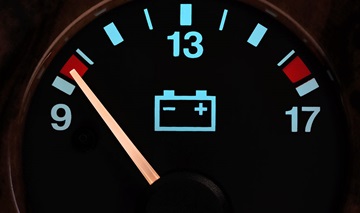
A battery warning light is an obvious sign your battery is dying. Newer cars may even show the voltage on your dashboard.
If your car is running, the battery should have between 13-15 volts. Anything more than 16 volts can damage your car.
However, voltage isn't a sign of how much longer you can trust your battery. It’s just showing how much power your battery has right now.
If you recharge a drained battery, it could be fine. But if it dies right after recharging, you need to replace the battery.
How to tell if a car battery is dying?
Check before it actually dies. Visit any place Interstate® is sold, and let the pros give you a fast, accurate battery test.
2. Flickering Headlights with the Engine Off
One of the easiest ways to tell if your car battery is dying is by watching the headlights in a dark garage. This only works with regular flooded batteries, and if you haven’t been driving in the last several hours. As soon as you get in the car, turn on the headlights. If they flicker within 60 seconds, you may need a new car battery.
If the car is running and the headlights flicker while you’re idling, that may be a sign of a bad alternator and a weak battery. A bad alternator will cause a lot of engine issues while the car is running, and can eventually kill a battery.
3. Glitching Electronics
Watch for electronic glitches like a window that hesitates before rolling down, a flickering cabin light or even the computer forgetting your Bluetooth connection or favorite radio station.
Your car battery powers everything when the engine’s off, including the computers and memory cards. If your car forgets a Bluetooth setting, that could mean the battery drained too low to keep power to a specific module. Losing power in this way is a telltale sign that the battery didn’t have enough voltage to power everything it is supposed to.
4. Rough Idling when the Engine Starts
If you start it and you feel hitches or jolts from the engine that fade away after a minute or two, you might have a dead battery.
This is because some sensors didn’t get enough power, or switches were not fully activated. If your battery is extremely drained, the car might display a check engine light or other warning light because a sensor didn’t get enough power.
If you can feel a slight pause that only lasts a quarter of a second, go get a battery test.
Ask for a free battery test at any of these 150,000 locations.
Where can you get a free battery test? Put in your city or ZIP code, and we'll show you dozens of locations nearby. Or just look for our logo in any of the auto shops near you.
5. Temperature Sensitivity
If the temperature drops overnight and your ignition doesn’t start within 30 seconds, you might be seeing the first sign that your battery is dying.
Weak batteries don't do cold. They can handle warm temperatures until they get so weak they flat out die, but low temperatures are the real battery killer.
A healthy car battery can withstand those overnight temperature drops. New car batteries are tested and designed to crank your car when it’s colder than 30 degrees below freezing. If a car battery can’t deliver the amps your car needs at zero degrees outside, then technicians would say it’s performing below the required specifications.
6. Battery Dead Right After Recharging
If you’ve recharged the battery or gone for a long drive and the ignition still hesitates, then the battery is dead or dying.
When a battery gets so weak that it can’t hold power, recharging it won’t do any good. Technicians and mechanics use the phrase “hammer dead” to describe this condition.
Try to recharge a hammer dead battery and you might energize it enough to pretend like a healthy battery for a very short period of time.
Dead batteries can happen any time.
Get a battery test, available wherever Interstate is sold, to replace batteries before they die. You may never need a jump again.
7. Everything Feeling Fine After Driving
Your car should operate optimally as soon as the ignition starts. However, if you feel like your car works better after driving for a while, you’ve got a good alternator keeping a weak battery going.
Car electronics are run mostly on the alternator, especially after you’ve been driving for 20-30 minutes. Before that, if things feel glitchy or rough, it’s because your battery isn’t helping much. If things even out only when the alternator's running hard, your car battery is losing strength.
Get a battery test to see if you can replace a bad battery before it fails.
Why It’s Hard to Tell If a Car Battery Is Dying
Batteries can appear to die suddenly because today's engines are more sophisticated than they were 30 years ago. Today's cars can compensate for a dying battery (but not fully recharge it.) The newer your vehicle is, the better the electrical system is at getting the most years out of every car battery.
It also means that when your battery dies, it doesn’t give you much warning, unless you know these signs of a dying car battery.
If you notice any of these signs, it's a safe guess that your battery's dying. As long as you regularly get a battery test with every oil change, you’ll stay ahead of any battery-related problems.
There's a repair shop near you. Let's find one now.
Interstate Batteries has a network of more than 150,000 auto repair shops, garages and more. One of them is nearby right now, ready to help you.